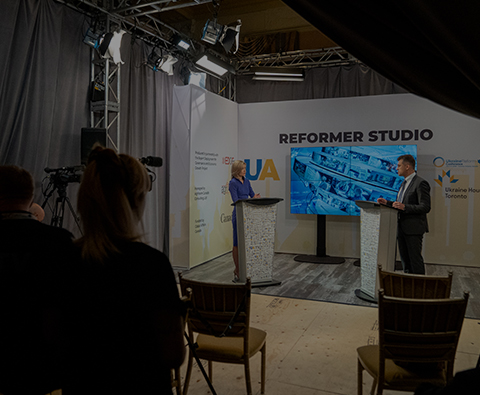

On 8 September 2026, UkraineInvest, together with the London Stock Exchange and HANetf, hosted the webinar “Going Global: The Journey to an International IPO”, bringing together leading international capital markets, accounting, legal and investment experts to provide Ukrainian companies with a practical roadmap for accessing global public equity markets.
Opening the webinar, Maryna Khlystun, CEO of UkraineInvest, highlighted the importance of complementing traditional foreign direct investment with new sources of equity capital. For Ukrainian businesses, international public markets can provide not only capital for expansion, but also greater visibility, stronger governance and access to a much broader international investor base. UkraineInvest’s objective is to support Ukrainian companies in becoming transparent, well-structured and investment-ready issuers capable of competing for global capital.
The discussion was moderated by Katya Gorbatiouk, Head of Investment Funds at the London Stock Exchange, and covered the full journey towards an international IPO, including:
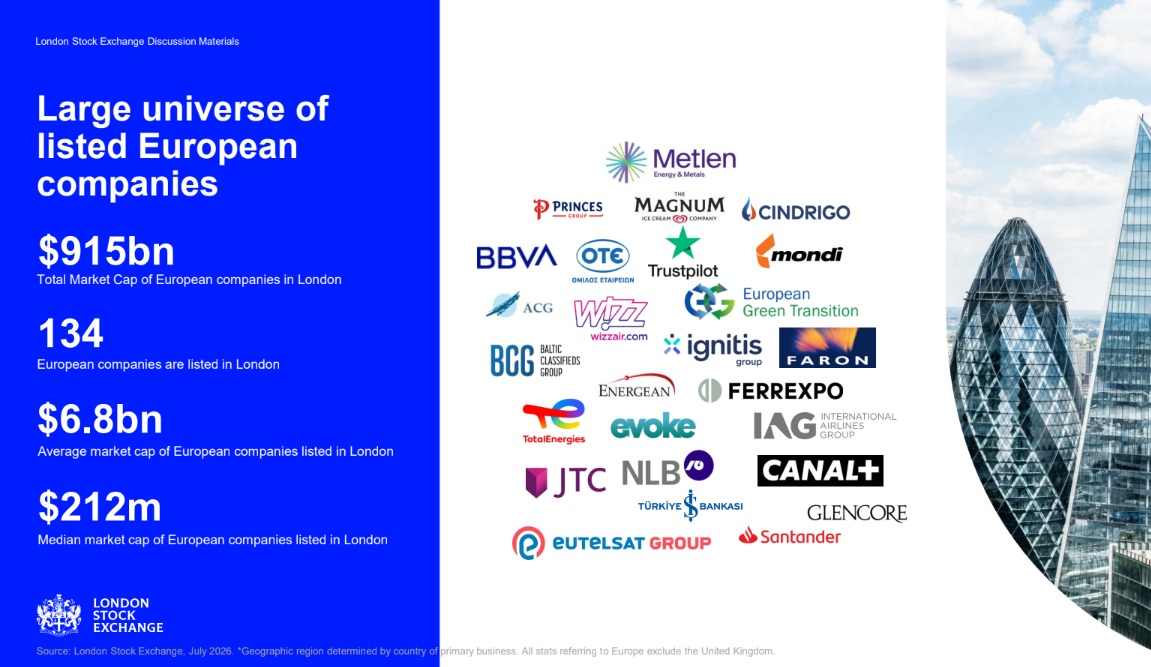
Chris McGahan, Senior Manager, Capital Markets at the London Stock Exchange, outlined why London remains one of the leading global venues for international companies.
Between 2023 and mid-2026, USD 89.9 billion was raised in London through 1,289 IPOs and follow-on offerings, approximately twice as much as on the next most active European exchange.
London also stands out for companies’ ability to return to the market after an IPO. According to the data presented during the webinar, 55% of London IPOs subsequently returned to raise additional capital, compared with 26% on Nasdaq and 23% on the NYSE for the period covered by the analysis.
This is particularly relevant for growing Ukrainian businesses: an IPO should not be viewed as a one-off fundraising event, but as the beginning of a long-term relationship with public capital markets, allowing companies to raise additional equity, finance acquisitions and broaden their investor base over time.
Recent reforms have also made the UK market more flexible for international issuers. The new listing framework simplified eligibility requirements and expanded flexibility around dual-class share structures and significant transactions.
At the same time, changes to FTSE rules have made index inclusion more accessible to international companies, which broadens the pools of available capital for international company IPOs. Eligible issuers trading in US dollars or euros can now enter the FTSE UK Series, the minimum free float for non-UK incorporated companies has been reduced to 10%, and large eligible new issuers may qualify for accelerated entry into the FTSE 100 or FTSE 250 as soon as five trading days after an IPO.
A central message of the webinar was that a successful IPO begins long before a company formally launches the transaction.
Robert Crowley, Partner at KPMG’s Capital Markets Advisory Group, identified four foundations of a successful IPO: a compelling equity story, preparation for listing requirements, robust financial reporting and effective corporate governance.
For a company considering an international listing, the key areas of preparation include:
For companies preparing for a listing, financial reporting is one of the longest lead-time workstreams. Businesses should expect to prepare historical financial information – typically covering up to three years where available – under IFRS or an equivalent standard, while also developing robust forecasting, budgeting, risk-management and internal-control systems.
According to KPMG, initial IPO-readiness work should ideally begin 18 months to two years before the intended listing window. This gives companies sufficient time to identify and address gaps before entering the intensive transaction phase.
Chris Ennals, Independent IPO Advisor, provided a practical step-by-step overview of the execution process.
Once a company has completed the initial readiness work, the formal IPO process brings together investment banks, lawyers, auditors and other advisers. The core preparation can broadly be divided into “the story, the numbers and everything else” – developing the investment proposition, aligning it with financial performance, completing due diligence and determining the transaction structure.
The process then progresses through early meetings with institutional investors, prospectus preparation and regulatory review, analyst research, investor education, management roadshows, bookbuilding and, finally, pricing and allocation. The intensive preparation phase itself may typically take around three to five months, followed by further regulatory, research and marketing stages.
For Ukrainian companies, an important early decision is where to list, as the choice of exchange will influence accounting standards, corporate governance requirements, internal controls, tax and legal structuring, as well as access to investors and indices. Chris Ennals noted that London has historically been an important listing venue for companies from Central and Eastern Europe and offers broad access to international investors, although the optimal venue will depend on each company’s sector, geography, peer group and structure.
He also stressed that Ukrainian companies need to build an equity story that answers several fundamental investor questions:
For Ukrainian issuers, two additional factors are particularly important. First, companies need to demonstrate operational and financial resilience – their ability to continue operating and generating results despite the challenges created by the war. Second, investors will look at whether the company offers credible exposure to Ukraine’s reconstruction and future economic growth. According to Ennals, the combination of proven resilience and a strong reconstruction-related growth opportunity can become an important part of the investment case for Ukrainian businesses approaching international markets.
Peter Magyar, Founder of Magyar & Co, focused on the legal considerations specific to Ukrainian businesses seeking an international IPO.
International investors and listing venues will closely assess issues such as sanctions exposure, ownership structures, assets connected to occupied territories, currency controls, property rights and other war-related legal risks. These issues do not automatically prevent an IPO, but they need to be identified, disclosed and, wherever possible, mitigated before a company approaches public markets.
For many Ukrainian companies, preparation may also require:
Corporate governance was highlighted as one of the most important legal aspects of IPO readiness. Investors will expect an appropriate degree of board independence, clear separation of responsibilities and effective procedures governing related-party transactions, audit, remuneration, whistleblowing and market-abuse compliance.
The key recommendation was to involve legal advisers early in the preparation process, rather than treating legal structuring as a final-stage task.
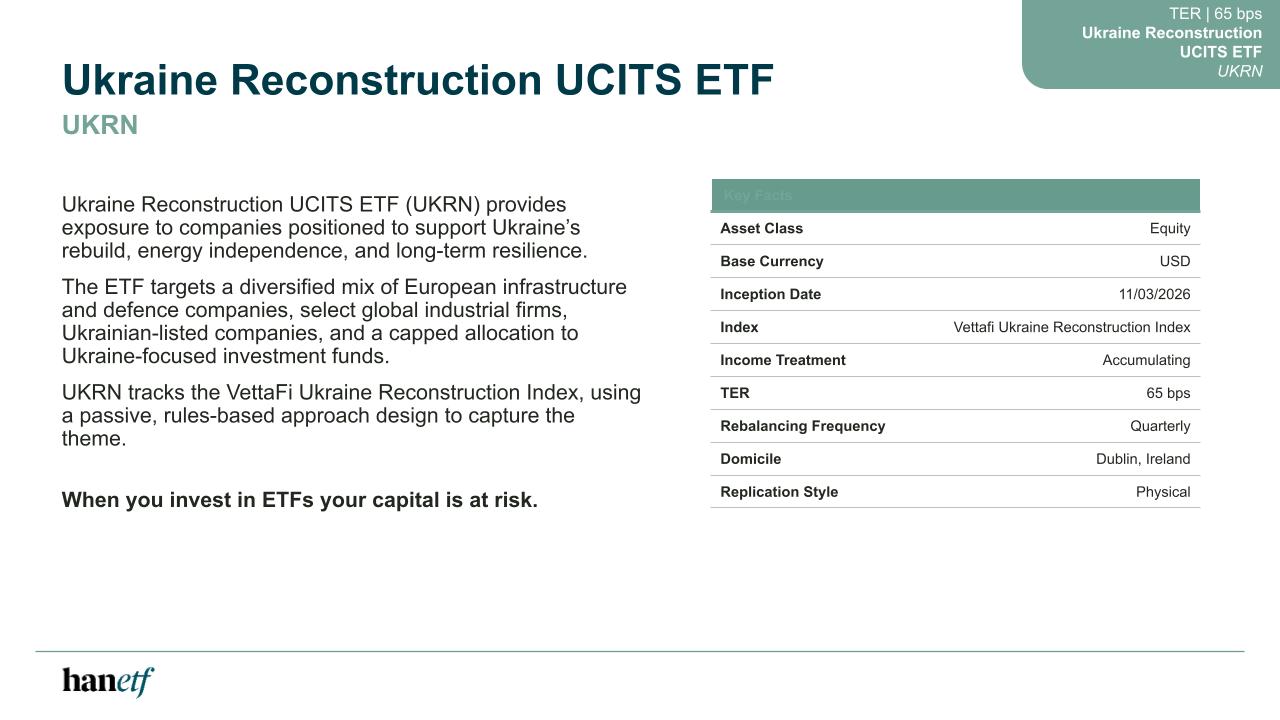
A separate focus of the webinar was the Ukraine Reconstruction UCITS ETF (UKRN) and the potential role of index-based investment in increasing international exposure to Ukrainian companies.
Hector McNeil, Co-CEO and Co-founder of HANetf, explained that UKRN provides exposure to companies positioned to support Ukraine’s reconstruction, energy independence and long-term resilience. The fund combines European infrastructure and defence companies, selected international industrial firms, Ukrainian-listed companies and a limited allocation to Ukraine-focused investment funds.
Importantly, the index methodology provides a dedicated pathway for Ukrainian issuers. Eligible Ukrainian companies have a minimum market capitalisation threshold of USD 50 million, compared with USD 100 million for other companies, and a minimum average daily trading volume of USD 0.5 million, compared with USD 1 million for other constituents. Ukrainian companies may also come from any sector.
The methodology also allows eligible Ukrainian IPOs to be included 10-50 days after listing, rather than waiting for the standard quarterly rebalancing cycle. This could help newly listed Ukrainian businesses reach international investors more quickly and support liquidity as Ukraine’s investable public market develops.
The first Ukrainian companies already included in UKRN are Kyivstar and Swarmer, both added to the index in April 2026.
The webinar also explored additional ways of connecting Ukrainian assets with international capital.
Alexandr Chernykh, Advocate, Representative of the Ukrainian National Bar Association in the UKaddressed securitisation and tokenisation of real-world assets, stressing that technology can improve distribution and investor access, but cannot replace the fundamentals of an investable asset: clear ownership, reliable cash flows, credible valuation, enforceable investor rights, transparency and regulatory compliance.
For Ukrainian companies, the key takeaway was that tokenisation should complement, rather than substitute, traditional securitisation and capital-market structures. The process should begin with the underlying asset and its economics, followed by the legal vehicle, investor rights, disclosure and compliance framework. Only after these foundations are in place should technology be added.
Alexandr Chernykh also emphasised that international investors and regulators will focus on the economic substance of an instrument, not simply its technological form or label. For Ukrainian businesses, this means that accessing international capital requires first creating transparent, well-structured and investable assets that can operate within trusted and regulated financial markets.
A successful IPO is not simply a financing transaction – it requires companies to strengthen financial reporting, governance and internal controls, build a credible equity story, resolve legal and ownership issues, and engage with investors early.
For Ukrainian businesses with international ambitions, public markets can provide access to long-term capital, global visibility and a broader investor base.
UkraineInvest will continue to help Ukrainian companies navigate international capital-market opportunities, connect with relevant partners and better understand the steps required to prepare for a potential listing. Companies interested in exploring these opportunities are welcome to contact UkraineInvest at [email protected].
Watch the full webinar recording on the UkraineInvest YouTube channel.
Follow us on Facebook, Twitter, LinkedIn, or YouTube.