
On 13–14 November 2025, Warsaw hosted the second EU–Ukraine Investment Conference ReBuild Ukraine 2025, organised by the European Commission. The event gathered more than 6,000 participants, 762 companies from 33 countries, and representatives of 160 Ukrainian municipalities. Its objective was to present EU investment instruments, showcase municipal project pitches (with total needs exceeding €5 billion), and strengthen partnerships for Ukraine’s large-scale reconstruction.
During ReBuild 2025, the European Commission announced new programmes and partnerships totalling €722 million, expected to mobilise up to €2 billion in investment. Several new agreements in renewable energy were also signed, including support for projects by Notus and Rengy Development. International partners reaffirmed their readiness to share risks with the private sector, further strengthening confidence in Ukraine’s investment landscape.
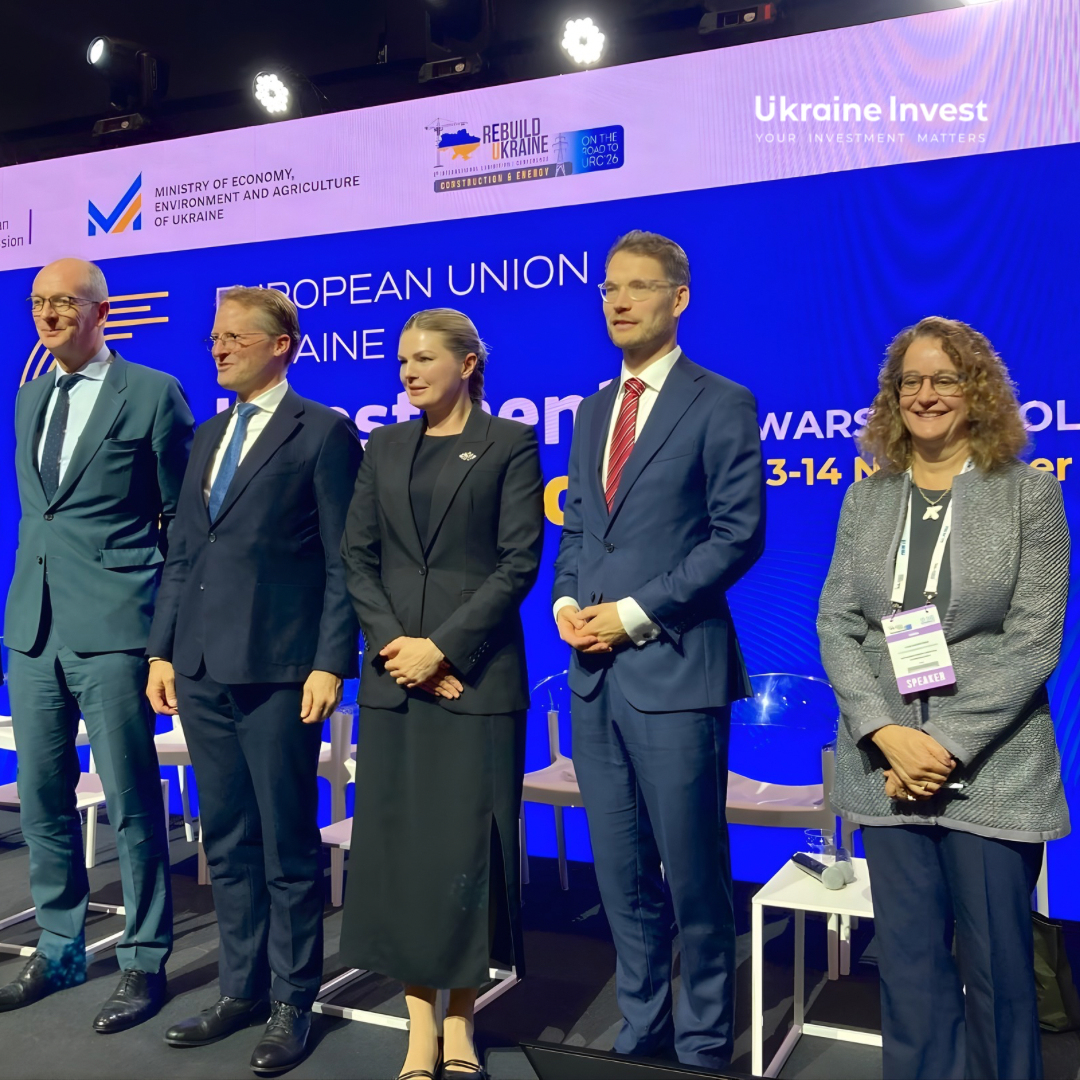
UkraineInvest was represented by Executive Director Maryna Khlystun, who moderated a high-level panel featuring major international partners and European businesses. Speakers included Gert-Jan Koopman, Director-General for Neighbourhood and Enlargement Negotiations (European Commission); Daria Marchak, Deputy Minister of Economy, Environment and Agriculture of Ukraine; Ole Egberg Mikkelsen, Special Envoy of Denmark for Private Sector Partnerships with Ukraine; Felix Tschudi, CEO of Tschudi Logistics; Joachim Goldbeck, CEO of Goldbeck Solar; Hannes Gellm, Regional Director at Notus; Mark Bowman, Vice-President of the EBRD; Teresa Czerwińska, Vice-President of the EIB; and Lisa Kestner, IFC Senior Country Officer for Ukraine.
The panel showcased the first practical results of the Ukraine Investment Framework (UIF), including the Tschudi Logistics hub in Western Ukraine, which is being financed through a €100 million EIB loan; the 120 MW Notus wind power plant in the Odesa region, supported by IFC and the EBRD; and a series of Goldbeck Solar projects with a combined capacity of more than 140 MW.
These initiatives leverage available government support instruments — including up to 30% CAPEX reimbursement, industrial park incentives, the Energy Derisking Fund, insurance premium compensation, as well as EIB financial tools and FDI support schemes. Collectively, they demonstrate the growing effectiveness of UIF in mobilising private capital into strategic sectors, whose total investment potential is estimated at up to $300 billion, against overall recovery needs of more than $500 billion.
Maryna Khlystun also joined the European Commission’s dialogue with companies that applied for investments exceeding €50 million under UIF. Seventy-eight percent of applicants are Ukrainian companies, many already featured on the Invest Portal. According to the latest RNDA4 private-sector needs assessment, Ukrainian businesses require approximately $8 billion in financing for recovery and scaling — a significant portion of which is demand for derisking capital and insurance mechanisms. These findings are now integrated into the design of new UIF instruments by the European Commission and international financial institutions.
UkraineInvest also held a series of bilateral meetings with international companies and institutions, including:
The European Commission further introduced new UIF financial instruments, including the Food4Impact (F4i) programme by Cardano Development with a budget of €78.75 million, aimed at supporting small and medium-sized agri-food processing companies. The Development Credit Program (DCP) was also presented, supporting medium-sized agricultural enterprises in modernising processing facilities, upgrading equipment and expanding production infrastructure.
The European Investment Bank announced the EU FDI & EU Single Market Integration programme with a total budget of €250 million, designed for investment projects starting from €25 million, including the acquisition of EU-manufactured equipment and the establishment of new production facilities in Ukraine by foreign investors. In addition, the EU approved several targeted grants and technical assistance packages: €51 million for social housing, €28.57 million for modernising water supply systems, €70 million for logistics infrastructure, €55 million for healthcare projects, and €127 million for an energy security investment grant to Naftogaz. In total, the approved package amounts to €722 million.
Key Outcomes of the Conference
Follow us on Facebook, Twitter, LinkedIn, or YouTube.