
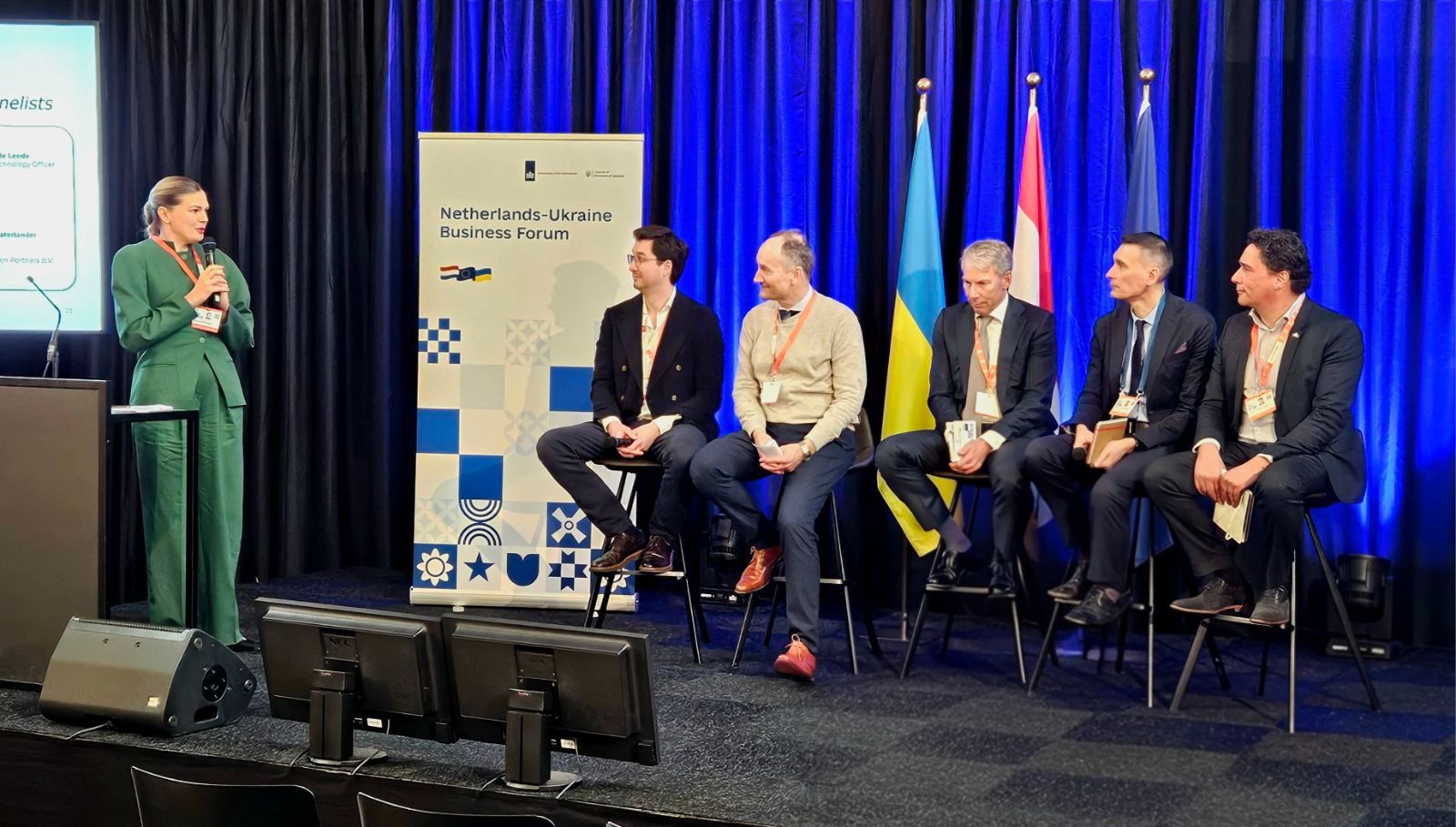
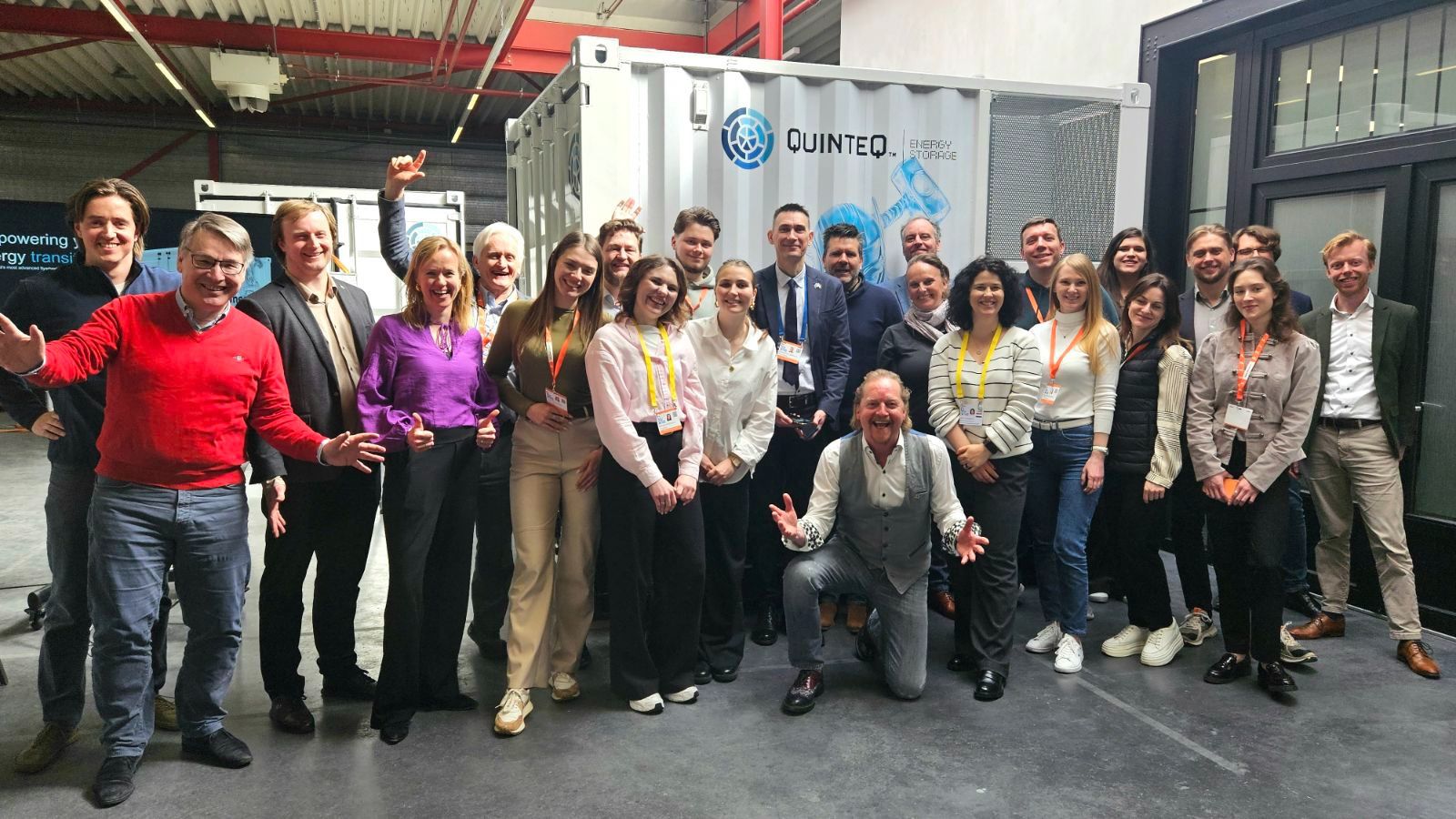
On March 30-31, the UkraineInvest team participated in the Netherlands-Ukraine Business Forum in Breda, which took place in conjunction with the second intergovernmental conference “Netherlands-Ukraine” (Lviv Conference). The two-day event brought together over 90 participants from both countries – representatives of Dutch and Ukrainian businesses, government agencies and financial institutions to explore specific trade and investment opportunities in the context of Ukraine’s recovery and its integration into the EU. The forum focused on three priority sectors: energy, agribusiness and cyclical construction.
As part of the forum, a roundtable was held with executives from Dutch companies and financial institutions, attended by Sjoerd Sjoerdsma, the Dutch Minister for Foreign Trade and International Development.
Participants discussed overcoming barriers to doing business in Ukraine and the growing interest of Dutch companies in the Ukrainian market, particularly in agribusiness, biofuels, and energy. Particular attention was paid to the development of innovative solutions, the need to strengthen regional cooperation, and the involvement of new partners in joint projects.
Investment opportunities in priority sectors
During the conference, Maryna Khlystun, Executive Director of UkraineInvest, moderated a panel discussion on investment opportunities in priority sectors. Opening the discussion, she outlined the scale of the prospects: Ukraine’s total reconstruction needs are estimated at $587.7 billion, while the investment potential over the next decade exceeds $300 billion in sectors where Dutch expertise and technological leadership have the greatest potential for implementation: energy ($167.6 billion), transport and logistics ($56.5 billion), agricultural sector ($34 billion), residential construction ($89.8 billion) and “green” metallurgy ($21.7 billion).
Together with discussion participants Raul Rosendal (VDL Group), Gerard de Lede (Solarge), Anton Kupava (Aircrete), Oleksandr Laktionov (Helios Strategia Group) and Otto Waterlander (Hydrogen Partners B.V. / UDPR), they discussed specific projects and real investment cases in key sectors: energy and circular construction. The speakers confirmed: despite the war, business is not standing still. In Ukraine, factories are being launched, solar power generation is being financed and new energy projects are moving from concept to physical implementation.
Key findings of the panel:
Financial capabilities and risk mitigation mechanisms
The second panel discussion, moderated by Anzhelika Varela, Head of International Cooperation at the KSE Institute, brought together representatives from leading financial institutions: Vyacheslav Ovechkin from the European Investment Bank, Olena Vol from the EBRD, Miriam Valstar from Invest International, Masaki Mackenzie from Atradius DSB and Yevheniy Garbar from ECA Ukraine. The participants discussed the practical aspects of financing and due diligence for projects in Ukraine today.
The key message of the session: a lack of financing is no longer a barrier for Ukraine – capital is available and already at work. The main challenge lies in properly structuring the instruments for a specific deal. Today, businesses have access to a full range of solutions: from large-scale loans and capital from international financial institutions (starting at $10 million) and support for medium-scale projects from development finance institutions (DFIs) ($5-10 million) to commercial bank financing for small and medium-sized businesses (up to $5 million), accompanied by universal investment insurance instruments and guarantees from export-credit agencies (ECAs).
Key findings of the panel:
On the sidelines of the forum, a Memorandum of Understanding was signed between the Odessa branch of the State Enterprise “Ukrainian Sea Ports Authority” and the Port of Rotterdam in the presence of Taras Kachka, Deputy Prime Minister for European and Euro-Atlantic Integration. The document provides for cooperation in the areas of port security, dredging, logistics, and innovation.
A special matchmaking session gave participants the opportunity to meet face-to-face to discuss potential cooperation. On the second day, the Ukrainian delegation visited Dutch companies (VDL, QuinteQ, TNO Lab and Green Village in Delft) to familiarize themselves with technologies that could be applied to Ukraine’s reconstruction.
The forum confirmed a clear message: Ukraine is not a market of the future, it is a market of today. Despite the ongoing war, the economy continues to grow, foreign direct investment is flowing in, and specific projects are receiving funding and being implemented. The investment climate is supported by an unprecedented level of international aid, an accelerated path to EU integration, and the government’s efforts to align the regulatory framework with investors’ needs. The Netherlands’ expertise in the fields of energy, agribusiness and circular construction directly addresses Ukraine’s most pressing reconstruction priorities, and the foundation for deepening cooperation has already been firmly laid.
UkraineInvest will support Dutch companies at every stage – from identifying opportunities to navigating the regulatory environment and addressing practical challenges on the ground. Reach out to us ([email protected]) to take the next step.
Follow us on Facebook, Twitter, LinkedIn, or YouTube.