
Securing financing for an investment project in Ukraine requires more than identifying a bank or investment fund. Companies need to understand which institutions finance their sector, what project sizes they consider, how much equity investors must contribute, and which instruments can help mitigate war-related and commercial risks.
On 12 November 2026, the European Commission (DG ENEST) and UkraineInvest brought together international financial institutions, development banks and investment funds for the closed-door workshop “Funding Solutions for Investment Projects in Ukraine”, held during ReBuild Ukraine 2026 in Warsaw.
The session focused on practical financing opportunities and direct engagement between businesses and financial partners. Financing instruments, investment criteria and approaches to working with companies in Ukraine were presented by:
The session was moderated by Mariia Repko, Deputy Director of the Centre for Economic Strategy and Key Expert of the EU-Ukraine Business Engagement Project.
The discussions highlighted an important distinction: financing is available through different channels, but the appropriate route depends on the project’s size, maturity, sector, financing structure and risk profile.
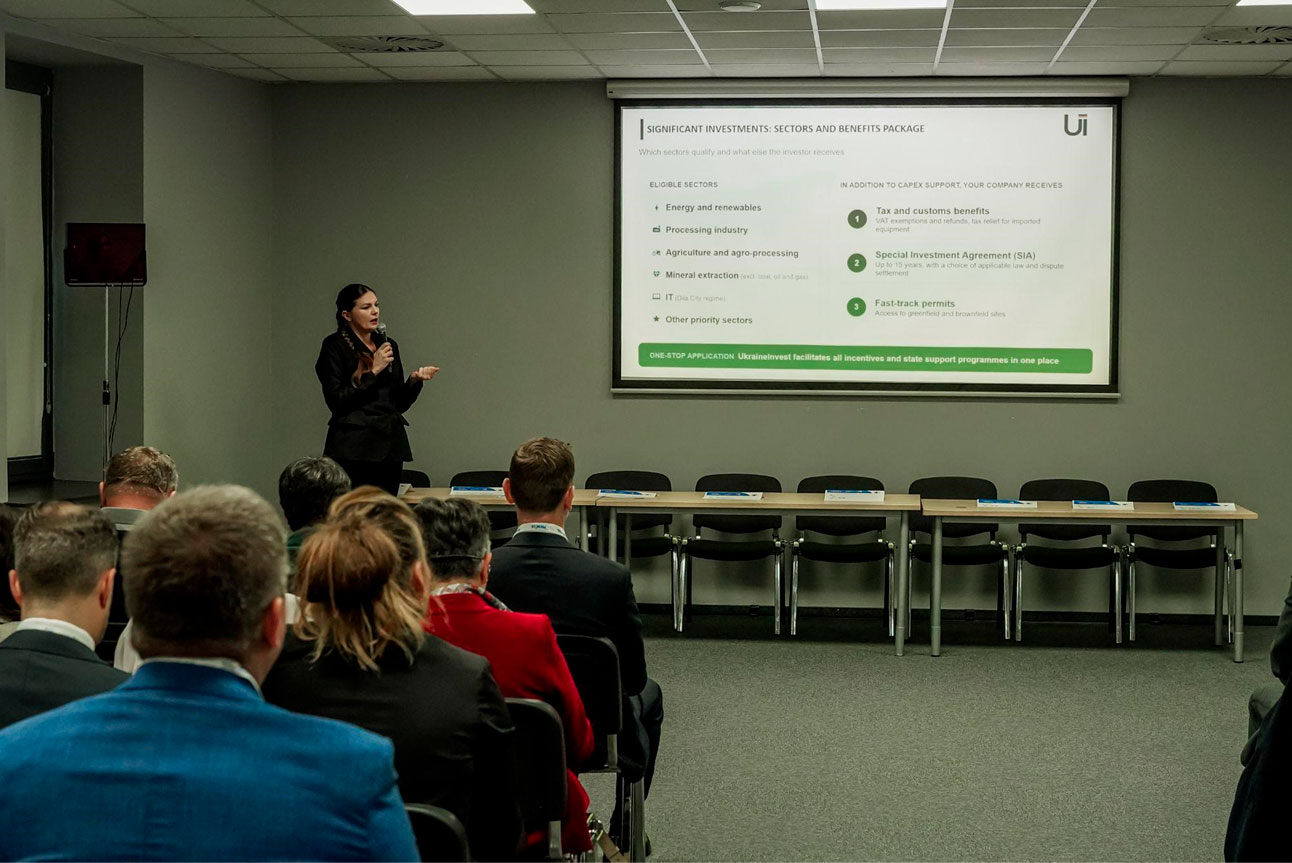
Maryna Khlystun, CEO of UkraineInvest, presented Ukraine’s investment landscape, including 396 screened projects featured in the investment project portfolio presented at the workshop, ranging from approximately $1 million to $1 billion per project.
The opportunities cover energy, manufacturing, agriculture and food processing, transport and logistics, construction materials, critical raw materials and other sectors, with projects at different stages of preparation.
She also outlined the principal state support mechanisms and investment opportunities available to businesses:
UkraineInvest supports companies in identifying investment opportunities, navigating financing and state support programmes, engaging with relevant financial institutions and public authorities, and addressing barriers to project implementation.
Serhiy Derkach, First Deputy Minister of Recovery, Infrastructure and Transport of Ukraine, presented opportunities for private capital under Ukraine’s updated public-private partnership (PPP) framework.
The Ministry has identified more than 30 potential PPP project ideas, including 17 evaluated projects with estimated CAPEX of approximately $2.9 billion. Of these, 12 projects representing around $1.5 billion in estimated CAPEX are under preparation across four sectors:
Mr. Derkach outlined changes introduced by the new PPP legislation, including more flexible project preparation and selection procedures, investor safeguards and opportunities to combine private investment with public funding and donor grants.
For businesses, these projects may offer opportunities to participate as investors, concessionaires, operators or contractors, depending on the project structure and procurement stage.
Interested companies can explore the Ministry’s PPP project portfolio and monitor upcoming competitive selection procedures.
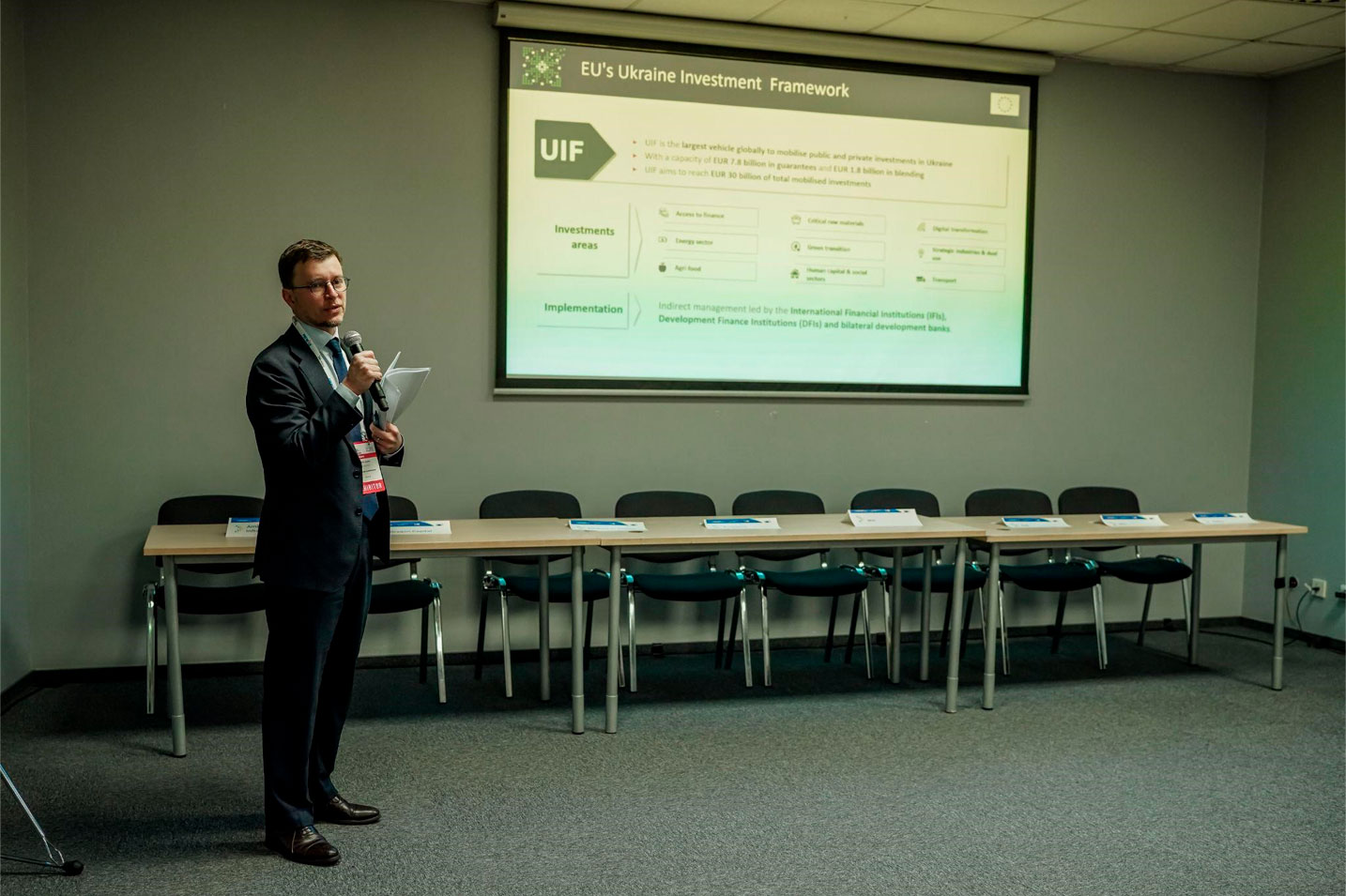
Gabriel Blanc, Team Leader for Ukraine Reconstruction at the European Commission (DG ENEST), presented the Ukraine Investment Framework (UIF), a key instrument under the EU’s €50 billion Ukraine Facility, supporting public and private investments in Ukraine.
The UIF provides €7.8 billion in guarantees and €1.8 billion in blending grants to mobilise public and private investments. As of November 2026, approximately €8.9 billion had been allocated to programmes, expected to mobilise €27.2 billion in investments.
Importantly, the UIF is not a single fund to which companies apply directly for loans or grants. The Framework operates primarily through implementing partners, including international financial institutions, national development banks and investment funds.
Depending on the programme, businesses may access:
The European Commission emphasised that allocation of UIF resources to programmes does not mean that all financing has already been disbursed to companies. Businesses can still access relevant programmes through their implementing financial institutions, subject to eligibility and availability.
Businesses can explore available opportunities and implementing partners through the UIF programme website.
Maurits-Jan Prinz, Deputy Head of Unit for Private Sector Engagement at DG ENEST, highlighted the European Commission’s direct engagement with businesses through the Call for Expressions of Interest, which remains open on a rolling basis.
Key eligibility criteria:
Projects are assessed based on strategic relevance, economic impact, financial viability and implementation readiness. Successful applicants may be connected with relevant financial institutions and potential investment partners.
The Commission reported that eight projects were progressing towards potential financing under UIF-backed programmes following its engagement with businesses.
How to apply: Companies must submit an online application, including a project fiche, company information and the required declarations.
The call is not a grant competition, and submission does not guarantee financing. The €50 million threshold applies only to this initiative.
The participating financial institutions, development banks and investment funds offer different financing instruments depending on project size, sector, maturity and investment structure.
The European Bank for Reconstruction and Development (EBRD) supports private-sector investment in Ukraine through direct financing, partner banks, trade finance and advisory services.
Since 2022, the EBRD has deployed €11.3 billion in Ukraine, with 86% of projects and 58% of financing directed to the private sector.
The Bank finances greenfield investments, acquisitions, joint ventures and business expansion projects, including those in manufacturing, energy and infrastructure. For direct project financing, the EBRD indicated financing amounts starting at around €10 million.
Smaller businesses can access financing through Ukrainian partner banks, supported by guarantees and risk-sharing mechanisms. The EBRD also works with 13 local financial institutions to support trade finance and provides technical assistance and advisory services to businesses.
To address war-related risks, the Bank supports insurance and risk-sharing instruments, including the Ukraine Recovery and Reconstruction Guarantee Facility (URGF) and Enterprise Security Enhancement (ESE).
Procurement opportunities are available for companies wishing to participate in public tenders. Links to the EBRD procurement platform are included in the presentation attached.
Companies seeking direct EBRD financing should prepare an investment proposal outlining project costs, financing needs, sponsor equity, projected cash flows and implementation readiness.
The International Finance Corporation (IFC) provides financing through loans, equity investments, guarantees, structured finance, trade finance, syndications and blended finance.
According to IFC, typical loan maturities are 7-12 years, while minority equity investments generally represent 5-20% ownership, depending on the transaction.
A particularly relevant instrument is IFC’s upstream engagement approach, which allows the institution to work with companies before their projects become fully investment-ready. Through this approach, IFC may help sponsors assess commercial potential, develop project structures, identify financing requirements and address obstacles to bankability.
Examples highlighted during the workshop included investments in agrifood processing, renewable energy, telecommunications and industrial development.
IFC also supports joint ventures and can help mobilise additional financing from other lenders and investors.
For companies with promising investment concepts but incomplete project preparation, early engagement with IFC may help determine whether the project can be developed into a bankable investment.
The European Investment Bank (EIB) presented financing opportunities for both European investors entering Ukraine and Ukrainian businesses seeking to expand their operations. The EIB Group has disbursed €3 billion in Ukraine since 2022, with €1.5 billion in new financing commitments in 2025 alone.
The Bank’s approach combines long-term lending with EU-backed guarantees, eligible grants, technical assistance and cooperation with export credit agencies.
For European companies, potential financing structures may combine an EIB loan, UIF grant resources and guarantees supporting political-risk coverage through export credit agencies.
For Ukrainian businesses, the EIB can consider arrangements combining EU-guaranteed financing with export credit agency-backed components, when projects involve European equipment, technologies or suppliers.
The EIB also emphasised flexibility in project size, including opportunities involving financing requirements below €25 million, subject to the applicable instrument.
The Bank does not require one standardised application form for all direct financing proposals. Companies can approach the EIB with investment concepts to discuss eligibility and potential financing structures.
Poland’s development bank, Bank Gospodarstwa Krajowego (BGK), presented an investment loan backed by an EU guarantee under the Ukraine Investment Framework.
Main financing conditions:
The programme is available to qualifying entities operating in Ukraine, including Ukrainian companies, special-purpose vehicles and branches of foreign businesses.
Projects must comply with applicable Ukraine Facility requirements concerning eligible entities and suppliers. Depending on the Polish component of the investment, an interest-rate subsidy may also be available.
This instrument is particularly relevant for companies with developed investment projects, identified sponsor equity and financing needs within the €5-50 million range.
BGK additionally offers export-related financing instruments for transactions involving Polish suppliers and exporters with Polish ECA (KUKE) involvement.
Proparco, part of the French Development Agency Group, supports private-sector investments through senior loans, guarantees, equity participation and technical assistance.
The institution presented indicative minimum financing tickets of approximately €8-10 million for both debt and equity investments. Loans can be provided in EUR or USD, with local-currency solutions potentially available through TCX. Equity investments are structured as minority participation alongside established sponsors or strategic investors.
Proparco’s activities in Ukraine focus on renewable energy, private equity funds, financial institutions and businesses providing essential goods, services and infrastructure.
Projects undergo financial, governance, environmental and social assessments, with IFC Performance Standards serving as an important reference.
Proparco may be suitable for established businesses and project sponsors seeking long-term financing or an equity partner, particularly where commercial viability and sponsor capacity are already demonstrated.
Finance in Motion is an impact asset manager supporting investment in Ukraine through the Green for Growth Fund (GGF) and the European Fund for Southeast Europe (EFSE).
The Green for Growth Fund finances renewable energy, energy efficiency and related infrastructure.
Indicative instruments include:
GGF’s project finance activities cover solar, wind, green gases, energy storage and infrastructure. The presentation indicated maximum leverage levels of 80% for eligible solar PV projects and 75% for eligible wind projects, subject to individual assessment. The fund also provides technical assistance for project preparation, technical studies, environmental and social assessments and certifications.
European Fund for Southeast Europe primarily supports SMEs through financial institutions and has presented plans for a direct financing pilot expected in early 2027.
The planned pilot targets upper SMEs and selected mid-cap businesses, particularly in agrifood value chains and manufacturing linked to European markets, including production modernisation, automation, digitalisation and resource efficiency.
Its indicative terms include debt financing of €3-15 million, with maturities of 2-8 years, potentially in EUR, USD or UAH.
The planned pilot should be distinguished from EFSE’s existing financing through partner institutions.
Amber Infrastructure and Dragon Capital presented their investment activities in Ukraine, including the European Flagship Fund for the Reconstruction of Ukraine.
The initiative aims to mobilise long-term capital for infrastructure and private-sector development, with a target fund size of up to €1 billion. The investment strategy covers two main areas: infrastructure, including energy, transport, logistics and digital infrastructure, and private equity, supporting companies in manufacturing, agriculture-related sectors, healthcare, construction materials, technology and consumer-oriented businesses.
For infrastructure projects, the managers described a focus on substantial equity requirements, including investments seeking approximately €20 million or more in equity capital.
For private equity transactions, indicative investment tickets were presented in the range of approximately $7-30 million.
Unlike traditional lenders, equity funds provide capital in exchange for ownership participation and may become actively involved in corporate governance, business development and long-term investment strategy.
This type of financing is particularly relevant for companies seeking additional shareholder capital, a strategic investor or an equity partner for a capital-intensive project.
War-related risks remain a significant constraint on investment financing in Ukraine. However, several insurance, guarantee and compensation mechanisms are available to help businesses mitigate these risks and improve access to financing.
EBRD Risk-Mitigation Instruments
The EBRD supports two mechanisms addressing different types of war-related exposure:
Investment insurance and international guarantees
Ukraine’s Export Credit Agency (ECA) offers insurance against war and political risks for qualifying direct investments and investment loans. Direct investment insurance is available for up to five years to investors holding at least 10% equity in a Ukrainian company.
Additional risk protection may be available through MIGA, DFC, international export credit agencies and private insurers, depending on the investment structure and type of exposure.
State Compensation Mechanisms
Ukraine also offers two separate state-backed programmes:
These instruments can complement one another, depending on project needs and eligibility. Companies should assess their exposure to physical damage, political, operational and financial risks, and confirm available coverage, exclusions and conditions with the relevant providers.
Integrating appropriate risk-mitigation instruments into a project’s financing structure can improve its investment readiness and bankability.
Project readiness is a key factor in securing investment financing. Financial institutions assess commercial viability, sponsor equity, project risks and implementation readiness.
War-related risks, insufficient equity and incomplete project documentation can delay financing. However, companies do not necessarily need a fully developed project before initiating discussions, as some institutions provide early-stage advisory and project preparation support.
Before approaching a financing partner, companies should prepare:
The documentation should reflect the institution’s financing approach.
Banks will assess the project’s ability to generate sufficient cash flow to service debt. Equity investors will focus more closely on growth potential, ownership, governance and expected investment returns.
Companies should be able to explain what financing they need, how it will be used and what remains to be completed before implementation.
The most appropriate financing route depends on the project profile:
Companies seeking opportunities as contractors or suppliers, rather than direct investment financing, can also monitor procurement opportunities through Prozorro and the EBRD Client E-Procurement Portal.
The essential principle is to identify the right financing structure, approach potential partners early and develop a credible project proposition supported by adequate sponsor equity and risk management.
UkraineInvest is Ukraine’s state investment promotion and support office, serving as a one-stop shop for investors.
It provides information and practical guidance on the investment environment, available incentives and financing instruments, helps investors navigate regulatory and administrative matters, and facilitates communication with public authorities, local partners and other stakeholders.
For companies seeking investment financing, UkraineInvest can help identify relevant financial instruments and risk-mitigation opportunities, facilitate engagement with potential partners and support project preparation and implementation.
UkraineInvest does not provide financing directly or replace the due diligence and investment decisions of financial institutions.
Looking for financing for an investment project in Ukraine? Contact UkraineInvest at [email protected] to discuss your project and explore available financing and investment support opportunities.
The financing terms and programme figures presented in this article reflect information shared during the workshop on 12 November 2026. Eligibility, financing availability, pricing, coverage and investment decisions remain subject to the requirements and assessment procedures of the relevant institutions.
Follow us on Facebook, Twitter, LinkedIn, or YouTube.