
UkraineInvest participated in the Ukraine Mine Action Conference (UMAC 2026), held in Brussels on 16-18 November, contributing to discussions on mobilising private capital, improving access to finance for demining operators and connecting humanitarian mine action with Ukraine’s economic recovery.
The fourth annual conference brought together representatives of governments, international financial institutions, donor organisations, private companies and mine action operators to strengthen cooperation on humanitarian demining. The event was jointly hosted by Ukraine and the European Union, in partnership with Belgium.
According to the European Commission, up to 132,000 km² of Ukrainian territory remain potentially contaminated by mines and explosive remnants of war. These hazards restrict access to agricultural land, industrial sites, transport networks and critical infrastructure, creating substantial barriers to economic activity and investment.
During UMAC 2026, international partners announced €70 million in funding for demining Ukrainian territory, reinforcing international support for restoring safe access to land and infrastructure.
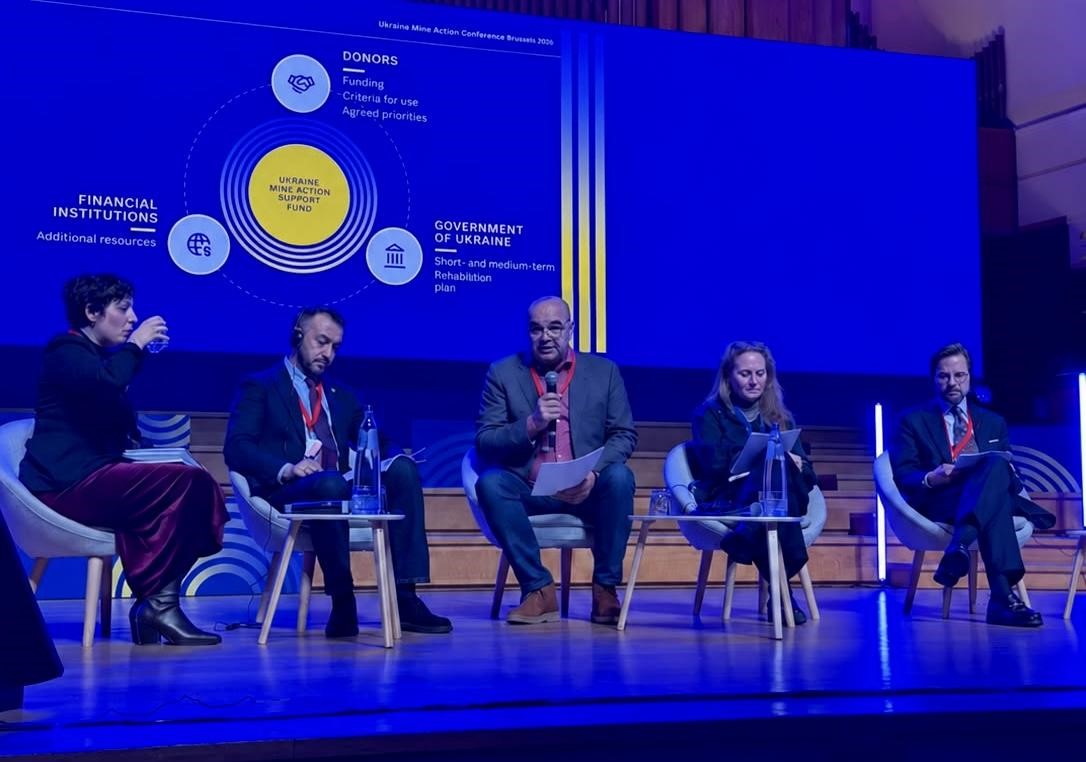
Andrii Ryzvaniuk, Acting Head of the Investment Advisory Department at UkraineInvest, participated in the panel discussion “Innovative Financing for Mine Action and Recovery”, alongside representatives of the Ministry of Economy and Environment of Ukraine, the European Bank for Reconstruction and Development (EBRD) and DanChurchAid.
The discussion examined how to encourage private-sector participation in financing humanitarian demining and improve access to financial resources for Ukrainian operators.
From an investment perspective, mine clearance generates economic benefits extending well beyond the immediate safety outcomes. Restoring access to agricultural land supports production and food processing, reopening transport routes reduces logistics costs, and clearing areas surrounding critical infrastructure enables businesses to restore operations.
However, these benefits often materialise over time and do not necessarily generate direct financial returns for those financing clearance activities. This creates a need for financing models that connect private-sector contributions with measurable economic outcomes.
UkraineInvest highlighted several approaches that could help address this challenge:
International experience provides practical examples of these approaches. In Cambodia, the Minefields to Rice Fields initiative combines mine clearance with agricultural development through a development impact bond. Private investors provide upfront funding, while outcome-based payments depend on independently verified results, including agricultural and livelihood improvements.
Similar mechanisms could be considered in Ukraine, particularly where clearance activities support identifiable economic beneficiaries and measurable recovery outcomes.
A separate focus of UkraineInvest’s contribution concerned the financial sustainability and bankability of Ukrainian demining companies.
For financial institutions, the ability to assess an operator’s previous performance, contractual obligations, operating costs and expected payment schedules is essential when considering lending opportunities.
Ukraine has already established a foundation for contract-based financing through its state programme compensating the cost of agricultural land demining.
According to the Humanitarian Demining Center, in 2025:
These results provide an operational track record that could help financial institutions assess lending opportunities for companies implementing verified demining contracts.
Access to working capital is particularly important because operators must cover personnel, equipment, fuel and maintenance costs before receiving final payments. Depending on contract structures and payment schedules, advances, short-term loans and partial guarantees could reduce these financing constraints.
Longer-term equipment financing could also become more accessible as operators develop predictable project pipelines and demonstrate the capacity to maintain sufficient equipment utilisation.
For UkraineInvest, humanitarian mine action represents an important enabling condition for attracting investment, restoring production capacity and supporting sustainable economic development.
Integrating demining priorities with infrastructure rehabilitation, agricultural development and investment planning can help ensure that safely cleared areas generate tangible long-term economic benefits.
Strengthening cooperation between businesses, financial institutions, mine action operators, donors and public authorities will be essential to expanding financing opportunities and accelerating the return of Ukrainian land and infrastructure to productive use.
UkraineInvest will continue contributing its investment facilitation expertise to discussions on financial instruments and partnerships that support Ukraine’s recovery and long-term economic growth.
Follow us on Facebook, Twitter, LinkedIn, or YouTube.